Every writer knows blank-page anxiety. One of the best antidotes is data: tracking your word count turns an abstract ambition into a concrete daily task. In 2026, writers are moving beyond spreadsheets toward tools that combine progress tracking, structure, and behavioral feedback.
1. WritersAlley
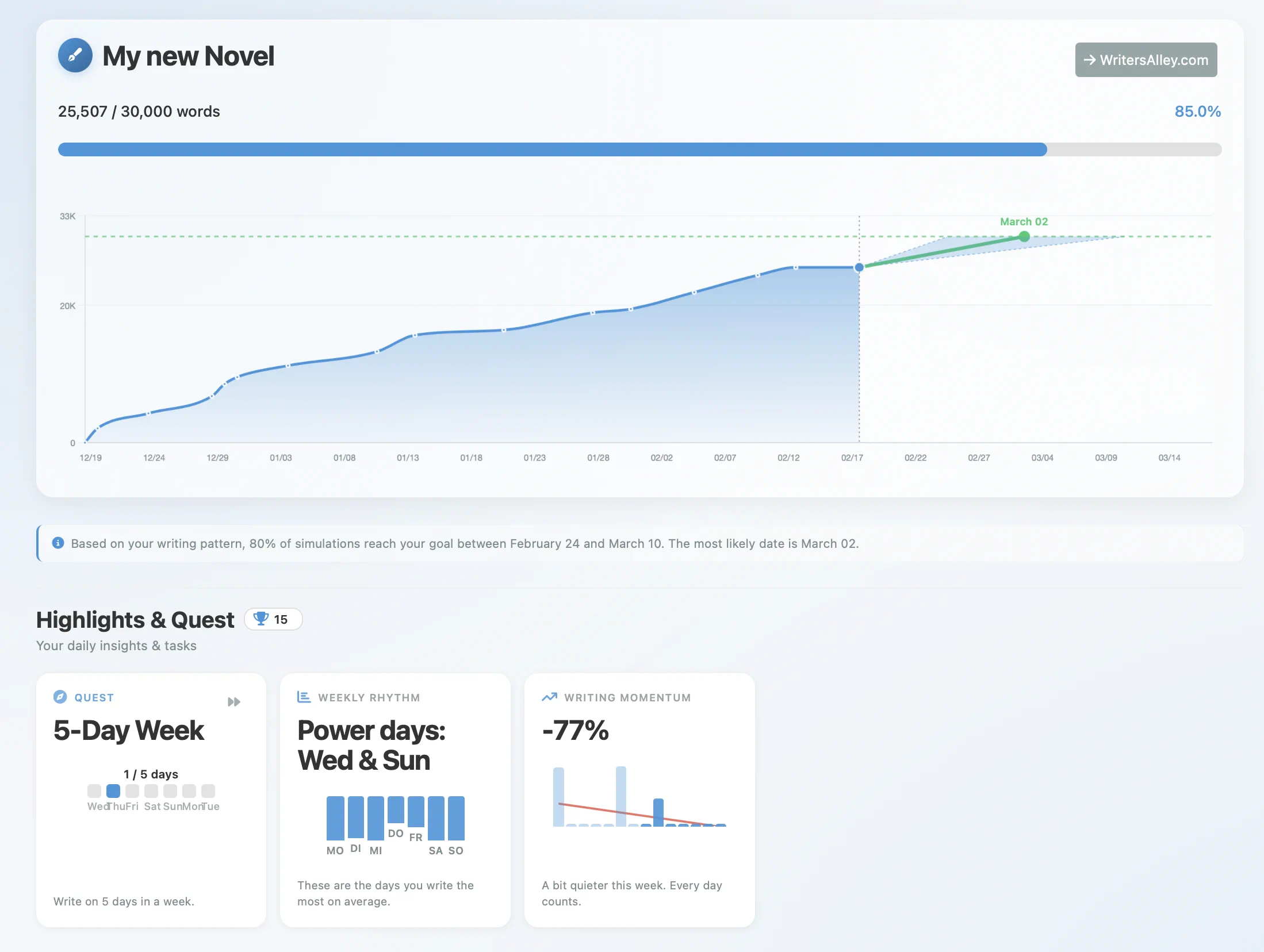
While many apps only count words, WritersAlley gives a broader progress view. You can create projects with clear goals, log sessions by date, and follow movement on a clean dashboard chart. Highlights, quests, and stat cards help writers stay engaged without cluttering the writing routine.
- Pros: Strong momentum tracking, minimalist interface, useful progress visibility across sessions.
- Cons: Feature-rich compared with pure timer-based tools.
If you want to build consistency fast, start with WritersAlley for free and log your next writing session.
2. 750 Words
750 Words is a simple daily-writing app built around consistency. Its low-friction approach works well for writers who want a clear, repeatable word-count habit without a heavy interface.
- Pros: Very straightforward daily target flow, distraction-light interface, strong habit focus.
- Cons: Fewer advanced analytics and planning features than broader writing suites.
3. MyWriteCap
MyWriteCap is built for writers who benefit from social accountability. Shared progress updates and leaderboard dynamics can create extra pressure to show up and write.
- Pros: Community momentum, leaderboard mechanics, easy progress sharing.
- Cons: Social features can distract from deep writing sessions.
4. WordCounter.net (Pro)
WordCounter.net has expanded from a simple counter into a broader tracking utility. It works well for quick checks and for monitoring output across browser-based writing environments.
- Pros: Fast, low-friction counting, broad web usage, useful overused-word signals.
- Cons: Limited long-term project planning depth.
5. ProWritingAid Progress Tracker
ProWritingAid combines editing and progress features, which is useful for writers who want to monitor quality and quantity in the same environment.
- Pros: Editing and tracking in one stack, strong integrations.
- Cons: Early drafts can feel over-analyzed when the focus should be output volume.
Comparison: Word Count Trackers at a Glance
| App | Primary Focus | Best Feature | Price |
|---|---|---|---|
| WritersAlley | Habit and Analytics | Progress and Consistency Insights | Free / Premium |
| 750 Words | Daily Habit Building | Simple Daily Target | Subscription |
| MyWriteCap | Social Accountability | Leaderboards | Free |
| WordCounter | Universal Tracking | Browser Extension | Free |
| ProWritingAid | Quality and Quantity | Style Integration | Subscription |
Final thought
Successful writers in 2026 are not only counting words, they are tracking habits. If your goal is a sustainable writing routine with visible progress, WritersAlley offers a strong balance between clarity and motivation.
Related Guides
FAQ
Does WritersAlley only track word count?
No. WritersAlley tracks words and also helps with project goals, progress visibility, and consistency habits.
Can WritersAlley help with writing consistency?
Yes. WritersAlley is designed to support consistent writing through session logging, progress charts, and motivation cues.
Is WritersAlley suitable for daily writing goals?
Yes. WritersAlley supports daily and long-term goals with clear metrics and visible milestones.